
English-speaking Caribbean
The Bahamas
A long chain of low coral islands where Columbus first landed in the Americas in 1492.
At a glance
Key dates
- 1492Christopher Columbus lands on an island the Lucayans called Guanahani, now usually identified with San Salvador.[2][3]
- 1718Woodes Rogers arrives as the first royal governor and drives out the pirates.[3]
- 7 January 1964The Bahamas gains internal self-government.[2][3]
- 10 July 1973The Bahamas becomes independent.[1][2]
- 2019Hurricane Dorian, a Category 5 storm, devastates Abaco and Grand Bahama.[8]
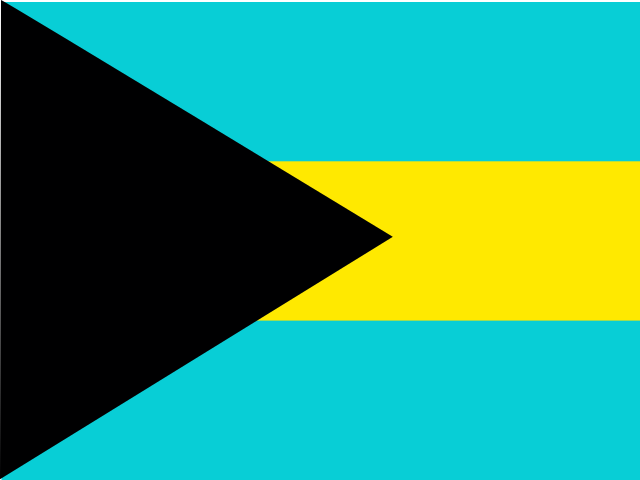
Flag and national symbols
Brief history
The Lucayans, a Taíno people, lived on the islands when Columbus arrived in 1492. Within a few decades they had been carried off or killed by the Spanish, and the islands were left almost empty.[2][3]
English settlers came in the 1600s. The islands became a base for pirates until Woodes Rogers arrived as royal governor in 1718 and restored British rule.[3]
Independence and government
The Bahamas won internal self-government on 7 January 1964 and full independence on 10 July 1973. It is a parliamentary democracy and a Commonwealth realm.[1][2]
Notable people
- Sir Lynden Pindling: Led the country to majority rule and independence and was its first Prime Minister.[6]
- Sir Sidney Poitier: Bahamian-American actor; the first Black man to win the Academy Award for Best Actor (for the 1963 film Lilies of the Field, awarded in 1964).[9]
- Shaunae Miller-Uibo: Olympic 400 m champion in 2016 and again at the Tokyo Games (2021).[10]
Use the sources to find more Bahamian leaders, writers and athletes.[2]
Geography
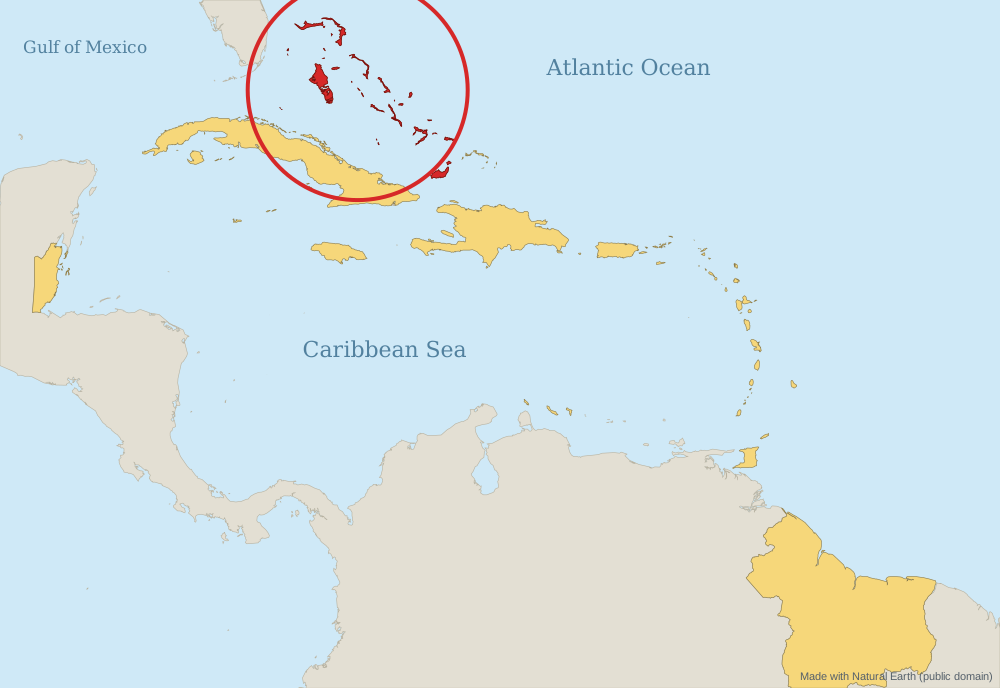
The Bahamas is a chain of hundreds of low coral islands and cays in the Atlantic Ocean, north of Cuba and south-east of Florida. The land is mostly flat; the highest point is only about 64 m.[1][2]
Hurricanes are the biggest natural hazard. Hurricane Dorian in 2019 was one of the strongest Atlantic storms on record to hit land.[8]
Culture, festivals, music and food
Junkanoo
Junkanoo is a street parade of music, dance and costumes, played with goatskin drums and cowbells. In The Bahamas it is held around the Christmas season.[7]
Rake-and-scrape
Rake-and-scrape is Bahamian folk music in which a carpenter's saw is scraped to make the beat.[11]
Primary School The Bahamas in a nutshell
- The Bahamas is made of many flat islands in the Atlantic Ocean. Its capital is Nassau.[1]
- Columbus first landed in the Americas here in 1492.[2]
Now try the quiz, or print the fact sheet.
Secondary School Going deeper
Pirates and governors
In the early 1700s Nassau was a pirate base. In 1718 Woodes Rogers arrived as royal governor to end piracy.[3]
Climate risk
Low, flat islands are exposed to hurricanes and rising seas. Hurricane Dorian (2019) shows why.[8]
Research questions
- Why might a flat, low island chain be especially at risk from hurricanes? Use the Hurricane Dorian article as one source.
- What do the marlin, flamingo and conch on the coat of arms tell you about the country?
Tip: use at least two sources and note where each fact comes from. The sources below are a good place to start.
Quick quiz
Choose an answer, then press Check. You will find out straight away. Nothing is saved or sent anywhere.
Fact sheet
A one-page summary of The Bahamas to print or save as a PDF.
Sources
Numbers in square brackets, like [1], show which source each fact comes from. All sources were checked on 14 November 2026.
- The World Factbook: The Bahamas (final edition, archived January 2026). Central Intelligence Agency (US). web.archive.org/web/2026/https://www.cia.gov/the-world-factbook/countr… (opens in a new tab)
- The Bahamas. Wikipedia. en.wikipedia.org/wiki/The_Bahamas (opens in a new tab)
- History of the Bahamas. Wikipedia. en.wikipedia.org/wiki/History_of_the_Bahamas (opens in a new tab)
- March On, Bahamaland. Wikipedia. en.wikipedia.org/wiki/March_On,_Bahamaland (opens in a new tab)
- Coat of arms of the Bahamas. Wikipedia. en.wikipedia.org/wiki/Coat_of_arms_of_the_Bahamas (opens in a new tab)
- Lynden Pindling. Wikipedia. en.wikipedia.org/wiki/Lynden_Pindling (opens in a new tab)
- Junkanoo. Wikipedia. en.wikipedia.org/wiki/Junkanoo (opens in a new tab)
- Hurricane Dorian. Wikipedia. en.wikipedia.org/wiki/Hurricane_Dorian (opens in a new tab)
- Sidney Poitier. Wikipedia. en.wikipedia.org/wiki/Sidney_Poitier (opens in a new tab)
- Shaunae Miller-Uibo. Wikipedia. en.wikipedia.org/wiki/Shaunae_Miller-Uibo (opens in a new tab)
- Rake-and-scrape. Wikipedia. en.wikipedia.org/wiki/Rake-and-scrape (opens in a new tab)
Last reviewed: 14 November 2026 (facts checked against the sources above by the Caribbean Cup of Tea team). Educator review: pending. This is a pilot page awaiting review by a teacher or education specialist.