
English-speaking Caribbean
Barbados
A coral island in the eastern Caribbean, famous for Crop Over, cricket and cou-cou and flying fish.
At a glance
Key dates
- 1627English settlers arrive; the island was uninhabited at the time.[1][2]
- 1816Bussa leads an uprising of enslaved people.[4]
- 1834Slavery is abolished.[1][2]
- 30 November 1966Independence from the United Kingdom (Independence Day).[1]
- 28 AprilNational Heroes Day, the birthday of Sir Grantley Adams.[4]
- 2011Historic Bridgetown and its Garrison becomes a UNESCO World Heritage Site.[3]
- 30 November 2021Barbados becomes a republic; Dame Sandra Mason is installed as the first President.[1][5]
Flag and national symbols
- Flag
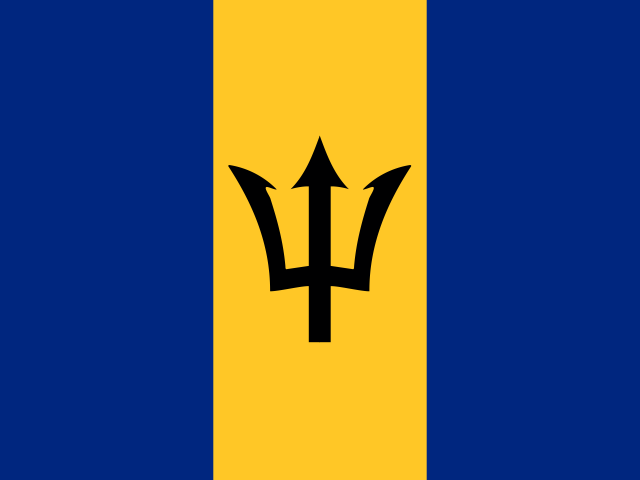
- Three vertical bands of ultramarine blue, gold and ultramarine blue, with a black trident head in the centre. Blue stands for the sea and sky, gold for the beaches, and the broken trident for independence and a break with the past.[1]
- National symbols
- Neptune's trident, the pelican, and the Pride of Barbados (red bird of paradise) flower.[1]
- Coat of arms
- A gold shield with two Pride of Barbados flowers and a bearded fig tree, held up by a dolphin and a pelican. The motto is “Pride and Industry”.[6]
- National anthem
- “The National Anthem of Barbados”, words by Irving Burgie and music by C. Van Roland Edwards, adopted in 1966.[1]
Brief history
People from northern South America settled Barbados around 1600 BCE, and Arawak and Carib peoples later lived on the island. Spanish and Portuguese sailors visited in the 16th century and gave the island its name.[2]
When English settlers arrived in 1627 the island was uninhabited. From the 1640s sugar became the main crop, grown on plantations worked by enslaved Africans. For a time Barbados led the Caribbean sugar industry.[1][2]
In 1816 Bussa led some 400 freedom fighters in a rebellion against slavery. Slavery was abolished in 1834. Labour protests in the 1930s and reforms in the 1940s and 1950s opened the way for Black political leaders and, finally, independence.[1][2][4]
Independence and government
Barbados became independent from the United Kingdom on 30 November 1966, with Errol Barrow as its first Prime Minister. It stayed in the Commonwealth.[1][9]
On 30 November 2021 Barbados became a parliamentary republic. A President replaced the British monarch as head of state, and Dame Sandra Mason became the first President. The Prime Minister leads the government.[1][2][5]
Notable people
- Bussa: Led the 1816 rebellion against slavery; a National Hero.[4]
- Sarah Ann Gill: Defended religious freedom despite threats; a National Hero.[4]
- Samuel Jackman Prescod: Newspaper editor who campaigned for the rights of the poor; a National Hero.[4]
- Sir Grantley Adams: First Premier of Barbados; National Heroes Day falls on his birthday, 28 April.[4]
- Errol Barrow: Led Barbados to independence in 1966 and became its first Prime Minister.[9]
- Sir Garfield Sobers: World-famous cricketer and one of the ten National Heroes named in 1998.[4][10]
- Rihanna (Robyn Rihanna Fenty): Singer and entrepreneur, named the 11th National Hero on 30 November 2021.[5]
Barbados has 11 National Heroes. The others are Charles Duncan O'Neal, Clement Payne, Sir Hugh Springer and Sir Frank Walcott.[4][10]
Geography
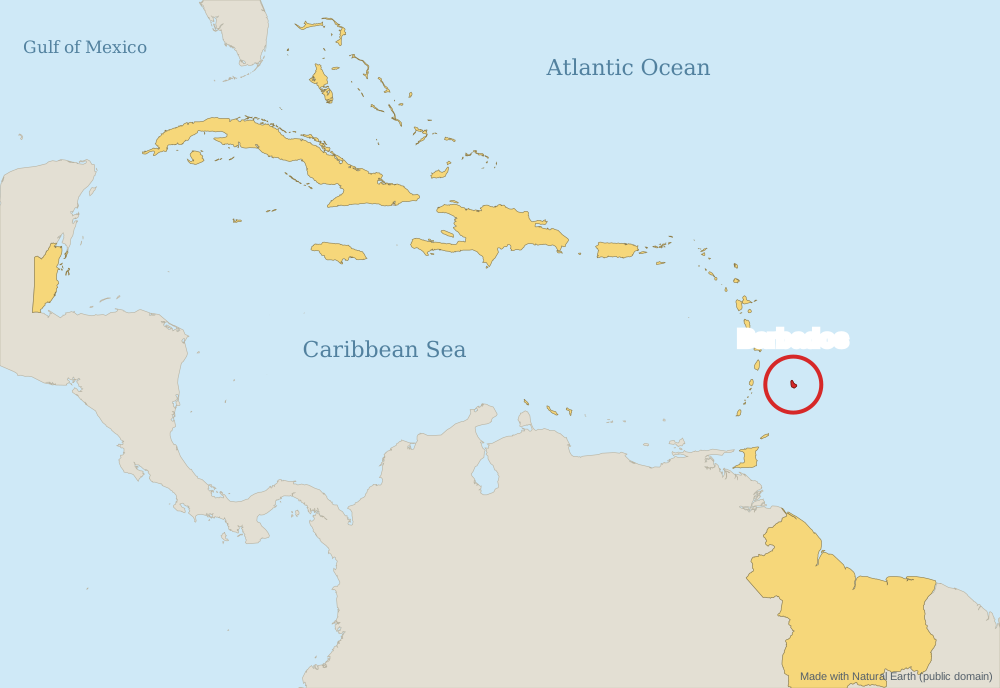
Barbados lies in the south-eastern Caribbean, about 160 km (100 miles) east of Saint Vincent and the Grenadines. It is roughly triangular, about 32 km long and 25 km wide.[2]
Most of the island is covered by a thick cap of coral limestone. It is fairly flat and rises gently to a central highland. In the north-east, the Scotland District has lost its coral cover to erosion.[1][2]
There are no large rivers or lakes. Rainwater soaks through the limestone into underground streams, which supply much of the island's water.[2]
The climate is tropical, with a rainy season from June to October. Hurricanes are infrequent, but the Great Hurricane of 1780 killed more than 4,300 people on the island.[1][2]
Barbados has 11 parishes and the city of Bridgetown.[1]
Culture, festivals, music and food
Festivals
Crop Over is a summer festival that grew out of celebrations at the end of the sugarcane harvest. It was revived in the 1970s and ends with Grand Kadooment, a carnival parade of costumed bands.[2]
Music and sport
Music is very popular, and the island hosts a jazz festival each January. Cricket is the national sport.[2]
Food
The national dish is cou-cou (cornmeal and okra) with stewed flying fish. Fish cakes made with salted cod are another favourite.[7][8]
Heritage
Historic Bridgetown and its Garrison is a UNESCO World Heritage Site. Its winding 17th-century streets and fortified port tell the story of British Atlantic trade, including the trade in enslaved people.[3]
Primary School Barbados in a nutshell
- Barbados is an island in the eastern Caribbean. Its capital is Bridgetown.[1]
- People in Barbados speak English. Many also speak Bajan.[1]
- Barbados became independent on 30 November 1966. In 2021 it became a republic with its own President.[1]
- The flag is blue, gold and blue, with a black trident in the middle.[1]
- The national dish is cou-cou and flying fish.[7]
- Every summer, people celebrate Crop Over with music, costumes and a big parade called Grand Kadooment.[2]
Now try the quiz, or print the fact sheet.
Secondary School Going deeper
Sugar and slavery
Within twenty years of English settlement, Barbados had turned to sugar. The plantation system depended on the forced labour of enslaved Africans, and Bridgetown became a hub for shipping both sugar and enslaved people to the rest of the Americas. By 1720 the Leeward Islands and Jamaica had overtaken Barbados as sugar producers.[1][2][3]
From colony to republic
After emancipation in 1834, sugar, rum and molasses remained the backbone of the economy for most of the 20th century. Workers' protests in the 1930s led to social and political reforms, and Barbados became independent in 1966. It helped found the Caribbean Free Trade Association in 1968, which became CARICOM in 1973. In the 1990s tourism and manufacturing overtook sugar, and in 2021 the country replaced the British monarch with an elected President.[1][2]
Research questions
- Why do you think Barbados became one of the richest sugar colonies so quickly after 1627? Use at least two sources.
- Compare Barbados's 1966 independence with its 2021 change to a republic. What changed, and what stayed the same?
- Choose one National Hero. What did they do, and why do you think the nation honours them?
- How does the geology of Barbados (coral limestone) affect where its water comes from?
Tip: use at least two sources and note where each fact comes from. The sources below are a good place to start.
Quick quiz
Choose an answer, then press Check. You will find out straight away. Nothing is saved or sent anywhere.
Fact sheet
A one-page summary of Barbados to print or save as a PDF.
Sources
Numbers in square brackets, like [1], show which source each fact comes from. All sources were checked on 12 November 2026.
- The World Factbook: Barbados (final edition, archived January 2026). Central Intelligence Agency (US). web.archive.org/web/2026/https://www.cia.gov/the-world-factbook/countr… (opens in a new tab)
- Barbados. Encyclopaedia Britannica. www.britannica.com/place/Barbados (opens in a new tab)
- Historic Bridgetown and its Garrison. UNESCO World Heritage Centre. whc.unesco.org/en/list/1376 (opens in a new tab)
- Let's Celebrate Our National Heroes. Barbados Government Information Service. gisbarbados.gov.bb/blog/lets-celebrate-our-national-heroes (opens in a new tab)
- Rihanna Named Barbados' 11th National Hero. Barbados Government Information Service. gisbarbados.gov.bb/blog/rihanna-named-barbados-11th-national-hero (opens in a new tab)
- Coat of Arms. Government of Barbados (GOV.BB). www.gov.bb/Visit-Barbados/coat-of-arms (opens in a new tab)
- Local Cuisine. Visit Barbados (Barbados Tourism Marketing Inc.). www.visitbarbados.org/local-cuisine (opens in a new tab)
- Holy Thursday Greetings. Barbados Fisheries Division. www.fisheries.gov.bb/holy-thursday-greetings (opens in a new tab)
- $50 Polymer Note: The Right Excellent Errol Barrow. Central Bank of Barbados. www.centralbank.org.bb/banknotes/2022-series-1/50-polymer-note (opens in a new tab)
- PM's National Heroes Day message (list of the 11 National Heroes). Barbados Today. barbadostoday.bb/2023/04/28/pms-national-heroes-day-message (opens in a new tab)
Last reviewed: 12 November 2026 (facts checked against the sources above by the Caribbean Cup of Tea team). Educator review: pending. This is a pilot page awaiting review by a teacher or education specialist.