
English-speaking Caribbean
Guyana
The “land of many waters” on the South American mainland, home of Kaieteur Falls.
At a glance
Key dates
Flag and national symbols
- Flag
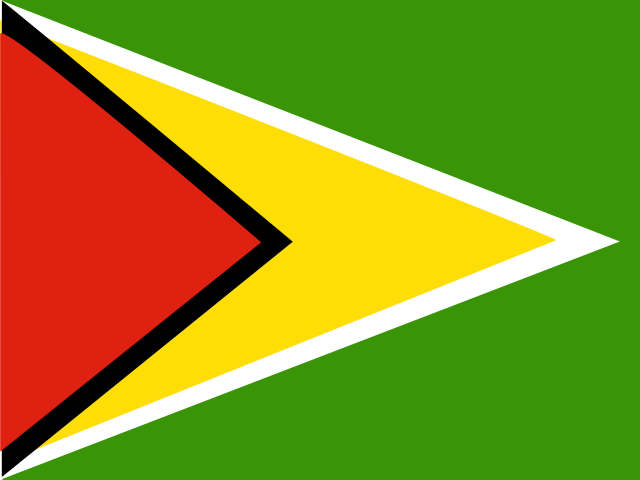
- The “Golden Arrowhead”: a red triangle and a gold arrowhead on green, edged in black and white. It was designed by Whitney Smith.[6]
- Motto
- “One people, One Nation, One Destiny”[2]
- National anthem
- “Dear Land of Guyana, of Rivers and Plains”: words by A. L. Luker, music by R. C. G. Potter.[7]
- National bird
- The hoatzin, also called the Canje pheasant.[8]
- National flower
- The giant water lily, Victoria amazonica.[2]
Brief history
Indigenous peoples lived here long before Europeans. The Dutch set up plantation colonies, and Britain took control of them in the early 1800s, joining them as British Guiana.[2]
Enslaved Africans resisted: in 1763 Cuffy led the Berbice uprising, and in 1823 came the Demerara rebellion. After emancipation, indentured workers came from India, which is why Guyana has large Afro-Guyanese and Indo-Guyanese communities.[2][3][4]
Independence and government
Guyana became independent on 26 May 1966 and a republic in 1970. Mashramani on 23 February celebrates Republic Day.[1][2][9]
Notable people
- Cuffy (Kofi): Led the Berbice uprising that began on 27 February 1763; today a national hero.[3]
- Clive Lloyd: Captained the West Indies to victory in the first Cricket World Cup in 1975.[10]
- Shivnarine Chanderpaul: One of the West Indies' highest Test run-scorers.[11]
Use the sources to find more Guyanese leaders, writers and athletes.[2]
Geography
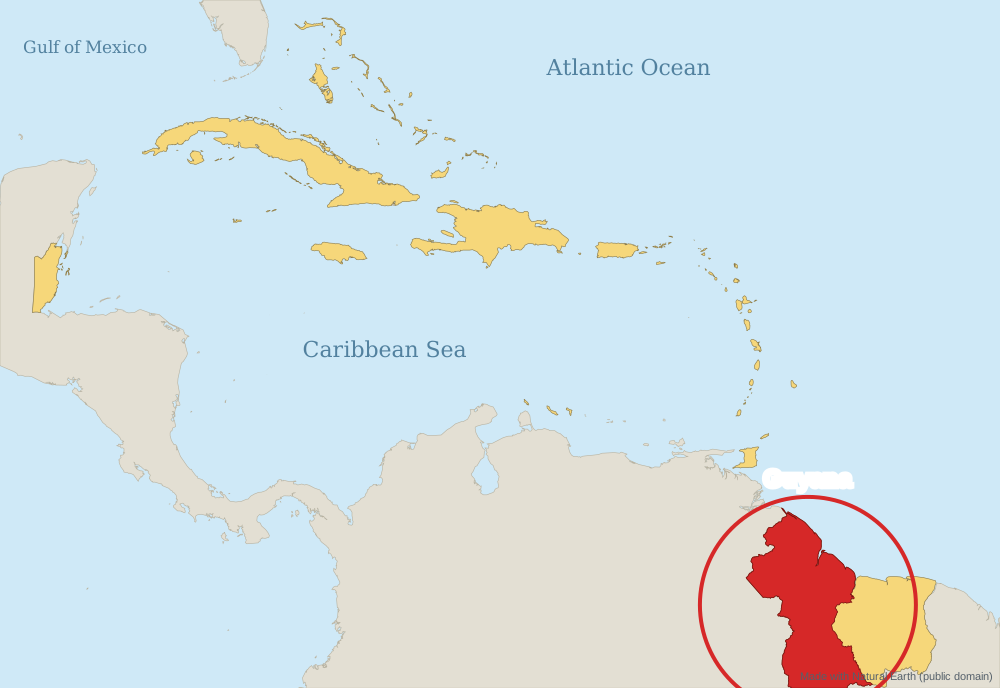
Guyana is on the north-east coast of South America, bordered by Venezuela, Brazil and Suriname. Most people live on the narrow coastal plain; the interior is rainforest, savannah and highlands.[1][2]
Kaieteur Falls on the Potaro River drops 226 m in a single fall, one of the most powerful waterfalls in the world.[5]
Culture, festivals, music and food
Mashramani
Usually held on 23 February, Republic Day, with a parade, music, games and cooking.[9]
Many peoples
Guyana's culture mixes Indigenous, African, Indian, European and Chinese traditions.[2]
Primary School Guyana in a nutshell
- Guyana is on the mainland of South America but is part of the Caribbean family. Its capital is Georgetown.[1][2]
- Kaieteur Falls is one of the most famous waterfalls in the world.[5]
Now try the quiz, or print the fact sheet.
Secondary School Going deeper
Resistance
Compare the Berbice uprising (1763) and the Demerara rebellion (1823): who led them and what happened next?[3][4]
Indenture
After 1838 workers came from India under indenture. How did this shape modern Guyana?[2]
Research questions
- Why is Guyana part of the Caribbean community even though it is on the South American mainland?
- What does the Golden Arrowhead flag say about the country? Use the flag article.
Tip: use at least two sources and note where each fact comes from. The sources below are a good place to start.
Quick quiz
Choose an answer, then press Check. You will find out straight away. Nothing is saved or sent anywhere.
Fact sheet
A one-page summary of Guyana to print or save as a PDF.
Sources
Numbers in square brackets, like [1], show which source each fact comes from. All sources were checked on 14 November 2026.
- The World Factbook: Guyana (final edition, archived January 2026). Central Intelligence Agency (US). web.archive.org/web/2026/https://www.cia.gov/the-world-factbook/countr… (opens in a new tab)
- Guyana. Wikipedia. en.wikipedia.org/wiki/Guyana (opens in a new tab)
- Berbice slave uprising of 1763. Wikipedia. en.wikipedia.org/wiki/Berbice_slave_uprising_of_1763 (opens in a new tab)
- Demerara rebellion of 1823. Wikipedia. en.wikipedia.org/wiki/Demerara_rebellion_of_1823 (opens in a new tab)
- Kaieteur Falls. Wikipedia. en.wikipedia.org/wiki/Kaieteur_Falls (opens in a new tab)
- Flag of Guyana. Wikipedia. en.wikipedia.org/wiki/Flag_of_Guyana (opens in a new tab)
- Dear Land of Guyana, of Rivers and Plains. Wikipedia. en.wikipedia.org/wiki/Dear_Land_of_Guyana,_of_Rivers_and_Plains (opens in a new tab)
- Hoatzin. Wikipedia. en.wikipedia.org/wiki/Hoatzin (opens in a new tab)
- Mashramani. Wikipedia. en.wikipedia.org/wiki/Mashramani (opens in a new tab)
- Clive Lloyd. Wikipedia. en.wikipedia.org/wiki/Clive_Lloyd (opens in a new tab)
- Shivnarine Chanderpaul. Wikipedia. en.wikipedia.org/wiki/Shivnarine_Chanderpaul (opens in a new tab)
Last reviewed: 14 November 2026 (facts checked against the sources above by the Caribbean Cup of Tea team). Educator review: pending. This is a pilot page awaiting review by a teacher or education specialist.