
English-speaking Caribbean
Jamaica
The third-largest Caribbean island, home of reggae and the Blue Mountains.
At a glance
Key dates
- 1494Christopher Columbus reaches Jamaica; Spain settles the island early in the 1500s.[1][2]
- 1655England seizes Jamaica from Spain.[1]
- 1692An earthquake destroys much of Port Royal.[7]
- 1834Slavery is abolished, freeing about a quarter of a million people.[1]
- 6 August 1962Independence from the United Kingdom (Independence Day).[1]
- 2015The Blue and John Crow Mountains become Jamaica's first UNESCO World Heritage Site.[6]
- 2018UNESCO recognises reggae music of Jamaica as intangible cultural heritage.[8]
- 2025Port Royal becomes Jamaica's second World Heritage Site.[7]
Flag and national symbols
- Flag
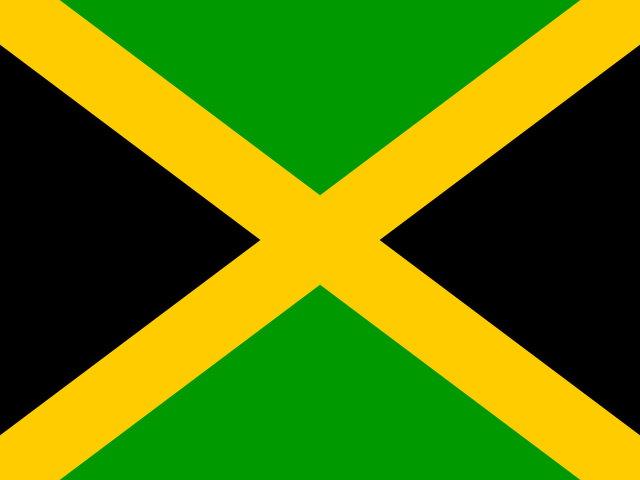
- A diagonal gold (yellow) cross divides the flag into two green triangles (top and bottom) and two black triangles (left and right). Green stands for hope and agriculture, black for hardships overcome, and gold for sunshine and natural resources. It was first raised at midnight as Independence Day began in 1962.[1][3][4]
- National symbols
- National bird: the doctor bird (swallow-tail hummingbird). National flower: lignum vitae. National tree: blue mahoe. National fruit: ackee.[3][4]
- Coat of arms
- A male and a female Taíno figure stand either side of a shield with a red cross and five golden pineapples, above the motto “Out of Many, One People”.[4]
- National anthem
- “Jamaica, Land We Love”, words by Hugh Sherlock and music by Robert Lightbourne, adopted in 1962.[1]
Brief history
The Taíno lived in Jamaica for centuries before Europeans arrived. Their name for the island, Xaymaca, is usually translated as “Land of Wood and Water”. Christopher Columbus arrived in 1494, and Spain settled the island early in the 16th century. The Taíno population was destroyed, and enslaved Africans were brought in.[1][2]
England seized Jamaica in 1655 and built a plantation economy based on sugar, cocoa and coffee, worked by enslaved Africans. Port Royal grew into one of the richest English ports in the Americas until an earthquake in 1692 sank much of the town.[1][7]
Maroons, people who escaped slavery, built communities in the mountains and resisted colonial rule. Slavery ended in 1834, and many freed people became small farmers.[1][6]
Independence and government
Jamaica joined the West Indies Federation in 1958, left it in 1961 and became fully independent on 6 August 1962. Its constitution came into force on that day.[1]
Jamaica is a constitutional monarchy and a Commonwealth realm. The British monarch, King Charles III, is head of state and is represented in Jamaica by a Governor-General. The Prime Minister leads the government.[1][2]
Notable people
- Nanny of the Maroons: Outstanding military leader of the Maroons in the First Maroon War against the British (1720–1739); a National Hero.[5]
- Samuel Sharpe: Main leader of the 1831 rebellion of enslaved people, which helped bring about the abolition of slavery; a National Hero.[5]
- Paul Bogle: Baptist deacon who led the 1865 protest march to the Morant Bay courthouse against poverty and injustice; a National Hero.[5]
- George William Gordon: Landowner and politician who stood up for freed people and sold land cheaply to small farmers; died in 1865; a National Hero.[5]
- Marcus Mosiah Garvey: Jamaica's first National Hero (1969); founded the Universal Negro Improvement Association in 1914.[5]
- Norman Manley: Lawyer who founded the People's National Party in 1938; a National Hero.[5]
- Sir Alexander Bustamante: Labour leader who organised workers in the 1930s; a National Hero.[5]
- Bob Marley: Singer and songwriter who helped make reggae popular around the world.[9]
Jamaica has seven National Heroes.[5]
Geography
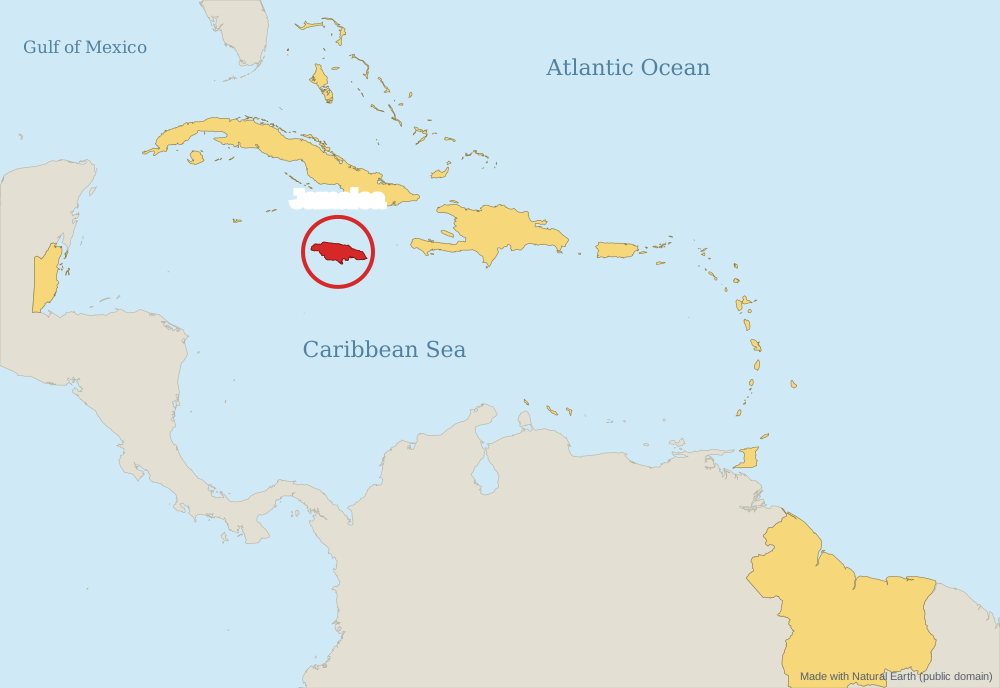
Jamaica is the third-largest island in the Caribbean, after Cuba and Hispaniola. It lies about 150 km (90 miles) south of Cuba and about 160 km (100 miles) west of Haiti.[1][2]
The island is mostly mountainous, with a narrow coastal plain. The Blue Mountains in the east rise to Blue Mountain Peak, the highest point. In the west, Cockpit Country is a limestone (karst) landscape of ridges and sinkholes.[1][2]
The climate is tropical and humid, cooler in the mountains. Hurricanes are a risk, especially from July to November. In October 2025 Hurricane Melissa struck as a Category 5 storm, the strongest ever recorded for the island.[1][2]
Jamaica is divided into 14 parishes.[1]
Culture, festivals, music and food
Music
Reggae grew out of earlier Jamaican styles, from ska to rock steady, mixed with Caribbean, North American and Latin influences. It began in Western Kingston as a voice for marginalised people and is now taught in schools and celebrated worldwide.[8]
Food
The ackee, the national fruit, first came from West Africa. Cooked with salted codfish, it makes ackee and saltfish, one of Jamaica's best-known dishes.[10]
Heritage
The Blue and John Crow Mountains are a World Heritage Site for both nature and culture: they sheltered the Taíno and then the Maroons, whose trails and settlements form the Nanny Town Heritage Route. The underwater and land remains of 17th-century Port Royal are a second World Heritage Site.[6][7]
Primary School Jamaica in a nutshell
- Jamaica is a big island in the Caribbean Sea, south of Cuba. Its capital is Kingston.[1]
- Jamaica became independent on 6 August 1962.[1]
- The flag is green, black and gold, with a gold cross.[1]
- The national bird is the doctor bird, a hummingbird with a long tail.[3]
- The motto is “Out of Many, One People”.[3]
- Reggae music comes from Jamaica.[8]
Now try the quiz, or print the fact sheet.
Secondary School Going deeper
Resistance and freedom
Jamaica's history is closely tied to resistance. In the mountains, Maroon communities fought the colonial system and built networks of trails and hiding places that are now protected as world heritage. Slavery was abolished in 1834, freeing about a quarter of a million people.[1][6]
Building a nation
Jamaica joined other British Caribbean colonies in the West Indies Federation in 1958 but withdrew in 1961 and became independent the next year. Its National Heroes include Marcus Garvey, who founded the Universal Negro Improvement Association in 1914 after seeing the poor living and working conditions of Black people in many countries, and Sir Alexander Bustamante and Norman Manley, who rose to leadership through the labour movement of the late 1930s.[1][5]
Research questions
- How did the Maroons use Jamaica's mountain landscape to resist colonial rule? Use the UNESCO description as one source.
- Why do you think Jamaica left the West Indies Federation in 1961? Find two different views.
- Choose one of Jamaica's seven National Heroes. What did they stand for, and how are they remembered today?
- How did reggae grow out of ska and rock steady, and why do you think UNESCO recognised it?
Tip: use at least two sources and note where each fact comes from. The sources below are a good place to start.
Quick quiz
Choose an answer, then press Check. You will find out straight away. Nothing is saved or sent anywhere.
Fact sheet
A one-page summary of Jamaica to print or save as a PDF.
Sources
Numbers in square brackets, like [1], show which source each fact comes from. All sources were checked on 12 November 2026.
- The World Factbook: Jamaica (final edition, archived January 2026). Central Intelligence Agency (US). web.archive.org/web/2026/https://www.cia.gov/the-world-factbook/countr… (opens in a new tab)
- Jamaica. Encyclopaedia Britannica. www.britannica.com/place/Jamaica (opens in a new tab)
- Jamaican National Symbols. National Library of Jamaica. nlj.gov.jm/jamaican-national-symbols (opens in a new tab)
- Coat of Arms; Symbols. Jamaica Information Service. jis.gov.jm/information/symbols/jamaican-coat-of-arms (opens in a new tab)
- Jamaica's National Heroes. Jamaica Information Service. jis.gov.jm/information/heroes (opens in a new tab)
- Blue and John Crow Mountains. UNESCO World Heritage Centre. whc.unesco.org/en/list/1356 (opens in a new tab)
- The Archaeological Ensemble of 17th Century Port Royal. UNESCO World Heritage Centre. whc.unesco.org/en/list/1595 (opens in a new tab)
- Reggae music of Jamaica. UNESCO Intangible Cultural Heritage. ich.unesco.org/en/RL/reggae-music-of-jamaica-01398 (opens in a new tab)
- Bob Marley. Britannica Kids. kids.britannica.com/students/article/Bob-Marley/329203 (opens in a new tab)
- Facts About Jamaica. Ministry of Foreign Affairs and Foreign Trade, Jamaica. mfaft.gov.jm/site/facts-about-jamaica (opens in a new tab)
Last reviewed: 12 November 2026 (facts checked against the sources above by the Caribbean Cup of Tea team). Educator review: pending. This is a pilot page awaiting review by a teacher or education specialist.