
Spanish-speaking Caribbean
Dominican Republic
Home of the Caribbean's tallest mountain, its oldest European city, merengue and bachata.
At a glance
- Currency
- Dominican peso (DOP)[1]
- Independence
- 27 February 1844 (from Haiti)[1]
- Government
- Presidential republic[1]
- Population
- About 10.9 million (2025 estimate)[1]
- Area
- About 48,670 sq km (18,790 sq miles)[1]
- Highest point
- Pico Duarte, 3,098 m (10,164 ft), the highest in the Caribbean[1]
- Motto
- “Dios, Patria, Libertad” (God, Fatherland, Liberty)[1]
Key dates
- 1492Christopher Columbus reaches the island the Taíno called Quisqueya.[1][2]
- 1498Santo Domingo is founded; it becomes the site of the first cathedral, hospital, customs house and university in the Americas.[3]
- 1838Juan Pablo Duarte founds the secret society La Trinitaria to work for independence.[4]
- 27 February 1844Independence from Haiti (Independence Day).[1][2]
- 16 AugustRestoration Day, a national holiday remembering the Grito de Capotillo of 16 August 1863, which started the war that restored independence from Spain in 1865.[1][2][10][11]
- 1990The Colonial City of Santo Domingo becomes a UNESCO World Heritage Site.[3]
- 2016 and 2019UNESCO recognises merengue (2016) and bachata (2019) as intangible cultural heritage.[6][7]
Flag and national symbols
- Flag
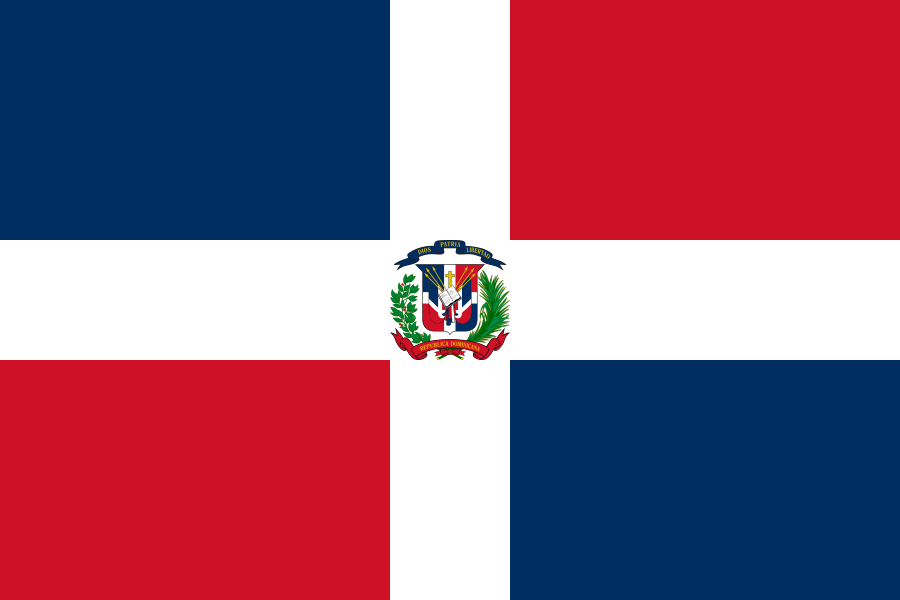
- A white cross divides the flag into four rectangles: blue and red on top, red and blue below. In the centre is a coat of arms with an open Bible, the motto “Dios, Patria, Libertad” and the words “República Dominicana”. Blue stands for liberty, white for salvation and red for the blood of heroes.[1]
- National flower and tree
- The Bayahíbe rose (flower) and the mahogany, or caoba (tree), named by Law 146-11.[5]
- National stone
- Larimar, a blue stone found on Hispaniola (Law 296-11).[5]
- National anthem
- “Himno Nacional”, also known as “Quisqueyanos valientes”, words by Emilio Prud'Homme and music by José Reyes, adopted in 1934.[1]
Brief history
Before Europeans arrived, the Taíno called the island Quisqueya and divided it into five chiefdoms. Columbus claimed the island in 1492, and it became the springboard for Spain's conquest of the Caribbean and the Americas. European diseases and forced labour quickly devastated the Taíno.[1][2]
Santo Domingo, founded in 1498, is the oldest permanent European settlement in the Americas. Its grid of streets became a model for town planners across the “New World”.[2][3]
In 1697 Spain recognised French rule over the western third of the island, which became Haiti. The eastern part tried to become independent in 1821, but Haiti ruled it for 22 years. Independence as the Dominican Republic came in 1844. The country returned to Spanish rule in 1861, then fought a war that restored independence in 1865.[1]
Independence and government
The Dominican Republic is an independent presidential republic: the President is both head of state and head of government. Its current constitution was proclaimed in 2015.[1][2]
Notable people
- Juan Pablo Duarte: Founded La Trinitaria in 1838; one of the three Fathers of the Nation (Padres de la Patria).[4]
- Francisco del Rosario Sánchez: Lawyer and soldier, an early member of La Trinitaria; a Father of the Nation.[4]
- Matías Ramón Mella: Member of La Trinitaria trusted by Duarte with secret missions; a Father of the Nation.[4]
Geography
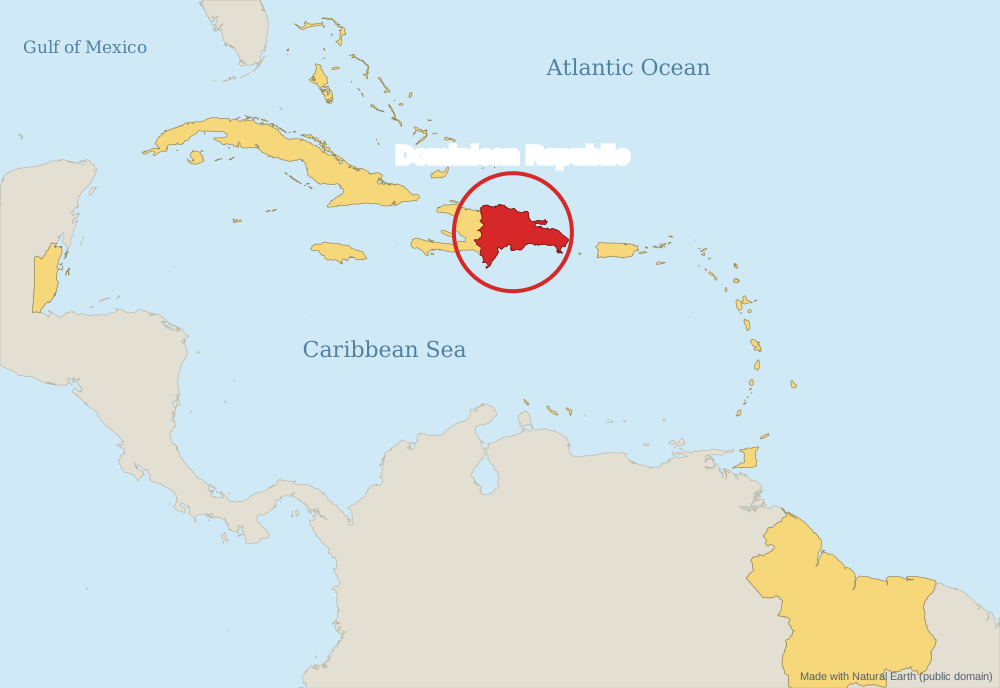
The Dominican Republic covers the eastern two-thirds of Hispaniola, which it shares with Haiti. It is the second-largest country in the Antilles, after Cuba, with the Caribbean Sea to the south and the Atlantic Ocean to the north. The Mona Passage separates it from Puerto Rico.[1][2]
The land has rugged highlands and mountains between fertile valleys. It holds the Caribbean's tallest mountain, Pico Duarte, and its lowest point and largest lake, Lago Enriquillo.[1]
The climate is tropical, with rainfall varying from very wet in the mountainous north-east to dry valleys near the Haitian border. Hurricanes can strike, mainly from June to October.[1][2]
The country has 31 provinces and a National District around Santo Domingo.[1]
Culture, festivals, music and food
Music and dance
Music and dance are central to social life. Merengue is considered part of the national identity, and bachata is another much-loved Dominican music and dance style; UNESCO has recognised both.[2][6][7]
Festivals
Carnival is celebrated for several weeks before Lent, with masked and costumed parades, especially in Santiago. National holidays on 27 February and 16 August remember the struggles for independence.[2]
Food
“La Bandera” (the flag) is a plate of white rice, beans and stewed meat named after the national colours. Sancocho, a stew made with several meats, root vegetables and other vegetables, is another iconic dish. Cassava bread, shared with neighbouring countries, is recognised by UNESCO.[8][9]
Heritage
The Colonial City of Santo Domingo is a UNESCO World Heritage Site, with the first cathedral, hospital, customs house and university in the Americas.[3]
Primary School Dominican Republic in a nutshell
- The Dominican Republic shares the island of Hispaniola with Haiti. Its capital is Santo Domingo.[1]
- People speak Spanish.[1]
- Independence Day is 27 February. The country became independent in 1844.[1]
- The flag has a white cross with blue and red boxes.[1]
- Pico Duarte is the tallest mountain in the whole Caribbean.[1]
- Merengue and bachata are famous Dominican music and dance.[6][7]
Now try the quiz, or print the fact sheet.
Secondary School Going deeper
Two independence days
Dominicans remember two struggles for independence. On 27 February 1844 the country broke away after 22 years of Haitian rule, led by members of La Trinitaria such as Duarte, Sánchez and Mella. After returning to Spanish rule in 1861, Dominicans began the War of Restoration, and independence was restored in 1865; 16 August is a national holiday.[1][2][4]
Dictatorship and democracy
Rafael Trujillo ruled as a dictator from 1930 to 1961. Juan Bosch was elected president in 1962 but overthrown in 1963, and the United States intervened in 1965 during a civil war. Joaquín Balaguer then held power for most of the next 30 years. Since 1996, regular competitive elections have been held.[1]
Research questions
- Why do you think Santo Domingo became the site of so many “firsts” in the Americas?
- Compare 27 February 1844 and 16 August 1863. What was each struggle against, and why are both remembered?
- How have Taíno, Spanish and African influences shaped Dominican culture today? Give examples from food, music or language.
- What role did La Trinitaria play in Dominican independence?
Tip: use at least two sources and note where each fact comes from. The sources below are a good place to start.
Quick quiz
Choose an answer, then press Check. You will find out straight away. Nothing is saved or sent anywhere.
Fact sheet
A one-page summary of Dominican Republic to print or save as a PDF.
Sources
Numbers in square brackets, like [1], show which source each fact comes from. All sources were checked on 12 November 2026.
- The World Factbook: Dominican Republic (final edition, archived January 2026). Central Intelligence Agency (US). web.archive.org/web/2026/https://www.cia.gov/the-world-factbook/countr… (opens in a new tab)
- Dominican Republic. Encyclopaedia Britannica. www.britannica.com/place/Dominican-Republic (opens in a new tab)
- Colonial City of Santo Domingo. UNESCO World Heritage Centre. whc.unesco.org/en/list/526 (opens in a new tab)
- Padres de la Patria. Ministerio de Relaciones Exteriores (MIREX), Dominican Republic. mirex.gob.do/padres-de-la-patria (opens in a new tab)
- Nuestros símbolos nacionales (Our national symbols). Acento (Dominican newspaper), Héctor Luis Martínez, 25 August 2024. acento.com.do/cultura/nuestros-simbolos-nacionales-9385657.html (opens in a new tab)
- Music and dance of Dominican merengue. UNESCO Intangible Cultural Heritage. ich.unesco.org/en/RL/music-and-dance-of-dominican-merengue-01162 (opens in a new tab)
- Dominican bachata. UNESCO Intangible Cultural Heritage. ich.unesco.org/en/RL/dominican-bachata-01514 (opens in a new tab)
- 5 Must-try Dishes of Dominican Gastronomy. Dominican Republic Ministry of Tourism (GoDominicanRepublic.com). www.godominicanrepublic.com/blog/post/5-must-try-dishes-of-dominican-g… (opens in a new tab)
- Traditional knowledge and practices for the making and consumption of cassava bread. UNESCO Intangible Cultural Heritage. ich.unesco.org/en/RL/traditional-knowledge-and-practices-for-the-makin… (opens in a new tab)
- Ministerio de Trabajo reitera 16 de agosto, Día de la Restauración, no se cambia. Presidencia de la República Dominicana. presidencia.gob.do/noticias/ministerio-de-trabajo-reitera-16-de-agosto… (opens in a new tab)
- La Guerra de la Restauración (The War of Restoration). Dirección General de Museos, Dominican Republic. dgm.gob.do/el-monumento-a-los-heroes-de-la-restauracion-se-ilumina-de-… (opens in a new tab)
Last reviewed: 12 November 2026 (facts checked against the sources above by the Caribbean Cup of Tea team). Educator review: pending. This is a pilot page awaiting review by a teacher or education specialist.