
French-speaking Caribbean
Haiti
The first country in the world founded by people who freed themselves from slavery.
At a glance
Key dates
- 1492Christopher Columbus lands on Hispaniola, home of the Taíno.[1]
- 1697Spain gives the western third of Hispaniola to France; it becomes the colony of Saint-Domingue.[1][4]
- 18 May 1803At the Arcahaie Congress, Jean-Jacques Dessalines creates the first Haitian flag. Haitians celebrate Flag Day on 18 May.[4]
- 18 November 1803French troops surrender at Vertières.[4]
- 1 January 1804Independence Day. Haiti becomes the first country led by formerly enslaved people.[1]
- 1982The National History Park (Citadel, Sans Souci, Ramiers) becomes a UNESCO World Heritage Site.[3]
- 12 January 2010A catastrophic earthquake strikes near Port-au-Prince.[1][2]
- 2021UNESCO recognises joumou soup as intangible cultural heritage.[5]
Flag and national symbols
- Flag
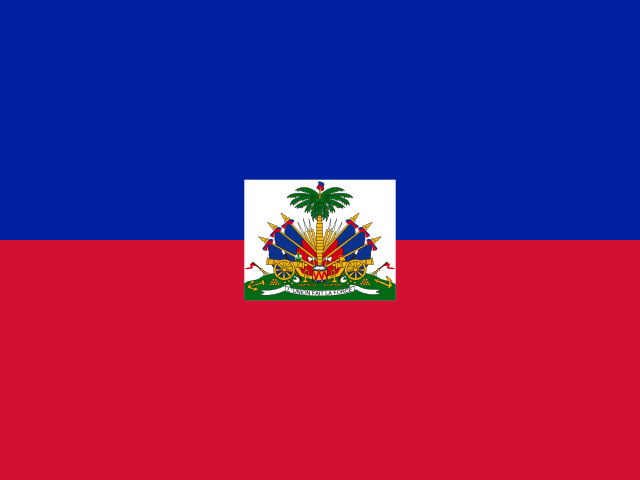
- Two equal horizontal bands of blue (top) and red, with a white rectangle in the centre showing the coat of arms. The colours come from the French flag and stand for the union of Haiti's peoples.[1][4]
- Coat of arms
- A palm tree topped by a liberty cap, with flags and cannons, above a scroll reading “L'Union fait la force”.[1][4]
- National symbols
- The Hispaniolan trogon (bird) and the hibiscus (flower).[1]
- National anthem
- “La Dessalinienne” (The Dessalines Song), words by Justin Lhérisson and music by Nicolas Geffrard, adopted in 1904 and named after Jean-Jacques Dessalines.[1]
Brief history
The Taíno lived on the island of Hispaniola when Columbus landed in 1492, and within 25 years they had been almost wiped out by Spanish settlers. The name Haiti comes from the Arawak name Ayti, meaning “Land of Mountains”.[1]
In 1697 Spain gave the western third of the island to France. The French colony of Saint-Domingue became one of the wealthiest in the Caribbean, but it was built on the forced labour of enslaved Africans.[1][4]
In the late 18th century Toussaint Louverture led a revolution of nearly half a million enslaved people. After he was captured and deported to France in 1802, Jean-Jacques Dessalines led the final struggle. French troops surrendered at Vertières in November 1803, and Haiti declared independence on 1 January 1804.[1][4]
Independence and government
Haiti won independence from France in 1804, the second country in the Americas, after the United States, to free itself from colonial rule. France later forced Haiti to pay a large indemnity for more than a century, and other countries shunned the new nation for decades; the United States recognised Haiti in 1862.[1][2]
Haiti is a republic. Its current constitution was adopted in 1987. In recent years the country has faced serious political instability and gang violence, and since 2024 it has been led by transitional authorities whose task is to prepare elections.[1][2]
Notable people
- Toussaint Louverture: Led the revolution against slavery and became governor of the whole island in 1801; captured in 1802, he died in prison in France.[1][4]
- Jean-Jacques Dessalines: Led Haiti to independence in 1804 and created the first Haitian flag; the national anthem is named after him.[1][4]
- Alexandre Pétion: Revolutionary leader who later ruled the south and west of Haiti and restored the blue and red flag.[4]
- Henri Christophe: Revolutionary general who ruled the north of Haiti, as King Henri I from 1811 to 1820.[4]
- Catherine Flon: Sewed together the blue and red bands of the first Haitian flag in 1803.[4]
Geography
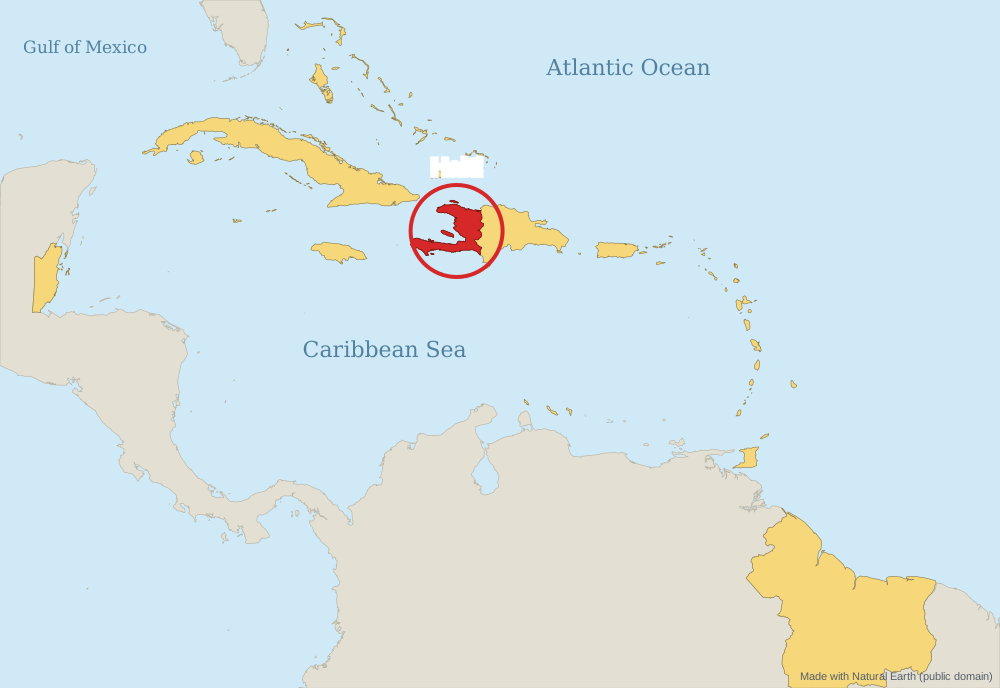
Haiti covers the western third of the island of Hispaniola, which it shares with the Dominican Republic. It also includes smaller islands such as Gonâve and Tortue (Tortuga). Cuba lies about 80 km (50 miles) to the west across the Windward Passage.[1][2]
It is the most mountainous nation in the Caribbean: about two-thirds of the land is above 490 m (1,600 ft). The Artibonite, the island's longest river, flows through Haiti to the Gulf of Gonâve.[1][2]
Haiti lies in the middle of the hurricane belt, with storms from June to October, and also faces earthquakes, floods and droughts. The earthquake of January 2010 caused enormous damage in and around Port-au-Prince.[1][2]
Haiti is divided into 10 departments.[1]
Culture, festivals, music and food
Food
Joumou soup, a pumpkin soup with vegetables, plantains, meat and spices, is eaten on 1 January, Independence Day, as the first meal of the year. Once reserved for slave owners, it became a symbol of freedom. Cassava bread, a tradition shared with neighbouring countries, is also recognised by UNESCO.[5][7]
Music and dance
Compas (kompa) is a popular Haitian music and dance genre with deep cultural meaning; UNESCO added it to its list of intangible heritage in 2025.[6]
Heritage
The Citadel, the Sans Souci palace and the buildings at Ramiers in northern Haiti date from the early 1800s. UNESCO calls them universal symbols of liberty, as the first monuments built by Black people who had won their freedom from slavery.[3]
Languages
Haitian Creole is the first language of most Haitians, while French is used in more formal settings and in schools.[2]
Primary School Haiti in a nutshell
- Haiti is on the island of Hispaniola. It shares the island with the Dominican Republic.[1]
- The capital is Port-au-Prince.[1]
- People speak Haitian Creole and French.[1]
- Haiti became free on 1 January 1804, after enslaved people won a long fight for freedom.[1]
- The flag is blue and red, with the coat of arms in a white box.[1]
- On New Year's Day, families eat joumou soup to celebrate freedom.[5]
Now try the quiz, or print the fact sheet.
Secondary School Going deeper
The Haitian Revolution
Saint-Domingue was one of the richest colonies in the Caribbean, but its wealth came from enslaved Africans. The revolution that began in the late 18th century ended French rule and created the first country in the world led by former slaves. Its leaders included Toussaint Louverture, Jean-Jacques Dessalines, Alexandre Pétion and Henri Christophe.[1][4]
The price of freedom
Independence came at a cost. France forced Haiti to pay an indemnity of 100 million francs, which took more than a century to pay, and many countries refused to recognise Haiti for nearly 40 years. The United States occupied Haiti from 1915 to 1934, and the country later lived through dictatorships and coups. Natural disasters, including the 2010 earthquake, have added to the challenges.[1][2]
Research questions
- Why is the Haitian Revolution important in world history, not just Caribbean history?
- How did the indemnity demanded by France affect Haiti's development? Find at least two sources.
- Why do you think joumou soup became a symbol of independence?
- Compare the history of Haiti and the Dominican Republic, which share the island of Hispaniola.
Tip: use at least two sources and note where each fact comes from. The sources below are a good place to start.
Quick quiz
Choose an answer, then press Check. You will find out straight away. Nothing is saved or sent anywhere.
Fact sheet
A one-page summary of Haiti to print or save as a PDF.
Sources
Numbers in square brackets, like [1], show which source each fact comes from. All sources were checked on 12 November 2026.
- The World Factbook: Haiti (final edition, archived January 2026). Central Intelligence Agency (US). web.archive.org/web/2026/https://www.cia.gov/the-world-factbook/countr… (opens in a new tab)
- Haiti. Encyclopaedia Britannica. www.britannica.com/place/Haiti (opens in a new tab)
- National History Park – Citadel, Sans Souci, Ramiers. UNESCO World Heritage Centre. whc.unesco.org/en/list/180 (opens in a new tab)
- Flag and Coat of Arms. Embassy of the Republic of Haiti, Washington DC. www.haiti.org/flag-and-coat-of-arms (opens in a new tab)
- Joumou soup. UNESCO Intangible Cultural Heritage. ich.unesco.org/en/RL/joumou-soup-01853 (opens in a new tab)
- The Compas of Haiti. UNESCO Intangible Cultural Heritage. ich.unesco.org/en/RL/the-compas-of-haiti-02273 (opens in a new tab)
- Traditional knowledge and practices for the making and consumption of cassava bread. UNESCO Intangible Cultural Heritage. ich.unesco.org/en/RL/traditional-knowledge-and-practices-for-the-makin… (opens in a new tab)
Last reviewed: 12 November 2026 (facts checked against the sources above by the Caribbean Cup of Tea team). Educator review: pending. This is a pilot page awaiting review by a teacher or education specialist.