
English-speaking Caribbean
Saint Lucia
A volcanic island of the Pitons that changed hands 14 times and produced two Nobel laureates.
At a glance
Key dates
- 1814After changing hands between France and Britain 14 times, the island becomes British for good.[2]
- 1967“Sons and Daughters of Saint Lucia” is adopted as the anthem.[4]
- 22 February 1979Saint Lucia becomes independent.[1][2]
- 1979W. Arthur Lewis wins the Nobel Prize in Economics.[6]
- 1992Derek Walcott wins the Nobel Prize in Literature.[5]
- 2024Julien Alfred wins Olympic gold in the 100 m, the country's first Olympic medal.[7]
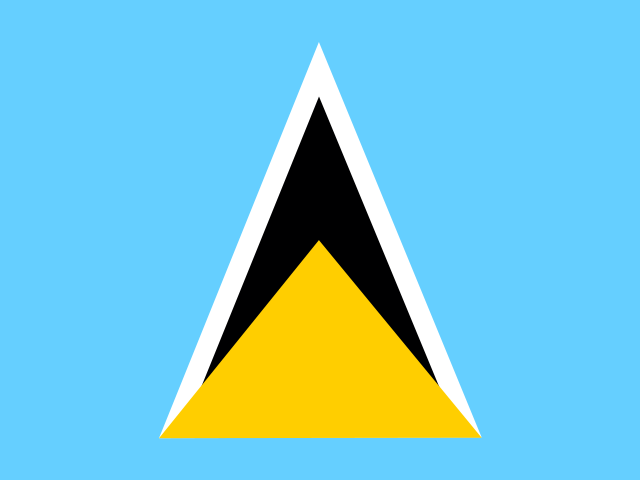
Flag and national symbols
Brief history
The Kalinago lived on the island when Europeans arrived. France and Britain fought over it so often that it changed control 14 times before Britain kept it from 1814.[2]
That history left a mix of English and French influence: English is the official language, while Kwéyòl, a French-based Creole, is spoken every day.[2]
Independence and government
Saint Lucia became independent on 22 February 1979. Sir John Compton was its first Prime Minister.[1][2][8]
Notable people
- Sir Derek Walcott: Poet and playwright; Nobel Prize in Literature, 1992.[5]
- Sir W. Arthur Lewis: Economist; Nobel Prize in Economics, 1979.[6]
- Julien Alfred: Sprinter; Olympic 100 m champion at Paris 2024.[7]
Saint Lucia has two Nobel laureates.[2]
Geography
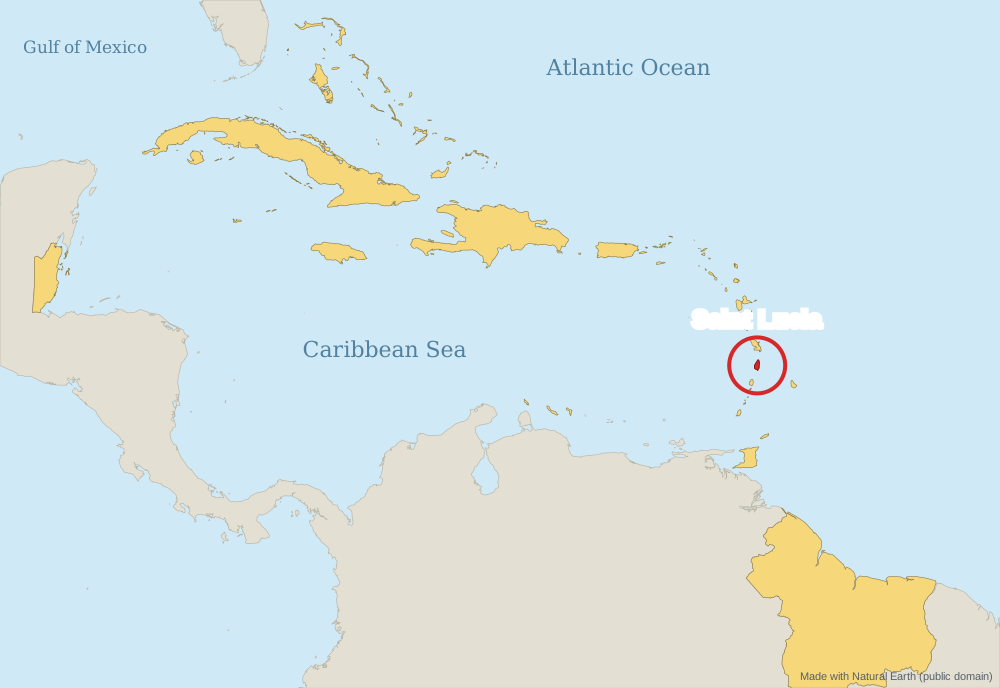
Saint Lucia is a mountainous volcanic island in the Windward Islands, between Martinique and Saint Vincent. The Pitons, two volcanic spires, are a UNESCO World Heritage Site.[1][2][3]
Near Soufrière are the Sulphur Springs, a drive-in volcanic area.[2]
Culture, festivals, music and food
La Rose and La Marguerite
Two flower festivals: La Rose on 30 August and La Marguerite on 17 October.[2]
Saint Lucia Jazz Festival
A well-known yearly music festival.[2]
Primary School Saint Lucia in a nutshell
- Saint Lucia is a green, mountainous island. Its capital is Castries.[1]
- The two Pitons are famous volcanic peaks.[3]
Now try the quiz, or print the fact sheet.
Secondary School Going deeper
Fourteen changes
Why did France and Britain want Saint Lucia so badly? Look at its harbours and position.[2]
Nobel island
How did Walcott and Lewis each write about the Caribbean?[5][6]
Research questions
- How can you still see both French and British history in Saint Lucia today?
- Why are the Pitons protected as a World Heritage Site?
Tip: use at least two sources and note where each fact comes from. The sources below are a good place to start.
Quick quiz
Choose an answer, then press Check. You will find out straight away. Nothing is saved or sent anywhere.
Fact sheet
A one-page summary of Saint Lucia to print or save as a PDF.
Sources
Numbers in square brackets, like [1], show which source each fact comes from. All sources were checked on 14 November 2026.
- The World Factbook: Saint Lucia (final edition, archived January 2026). Central Intelligence Agency (US). web.archive.org/web/2026/https://www.cia.gov/the-world-factbook/countr… (opens in a new tab)
- Saint Lucia. Wikipedia. en.wikipedia.org/wiki/Saint_Lucia (opens in a new tab)
- Pitons (Saint Lucia). Wikipedia. en.wikipedia.org/wiki/Pitons_(Saint_Lucia) (opens in a new tab)
- Sons and Daughters of Saint Lucia. Wikipedia. en.wikipedia.org/wiki/Sons_and_Daughters_of_Saint_Lucia (opens in a new tab)
- Derek Walcott. Wikipedia. en.wikipedia.org/wiki/Derek_Walcott (opens in a new tab)
- W. Arthur Lewis. Wikipedia. en.wikipedia.org/wiki/W._Arthur_Lewis (opens in a new tab)
- Julien Alfred. Wikipedia. en.wikipedia.org/wiki/Julien_Alfred (opens in a new tab)
- John Compton. Wikipedia. en.wikipedia.org/wiki/John_Compton (opens in a new tab)
- Saint Lucia amazon. Wikipedia. en.wikipedia.org/wiki/Saint_Lucia_amazon (opens in a new tab)
Last reviewed: 14 November 2026 (facts checked against the sources above by the Caribbean Cup of Tea team). Educator review: pending. This is a pilot page awaiting review by a teacher or education specialist.