
English-speaking Caribbean
Trinidad and Tobago
The twin-island republic that gave the world the steelpan, just off the coast of South America.
At a glance
Key dates
- 1498Christopher Columbus names the larger island “La Isla de la Trinidad” (the Island of the Trinity).[1]
- Early 1800sBritain takes control of Trinidad from Spain.[1]
- 1834Emancipation of enslaved people.[1]
- 1845–1917Contract workers arrive from India.[1]
- 1910Oil is discovered on Trinidad.[1]
- 31 August 1962Independence from the United Kingdom (Independence Day).[1]
- 1976Trinidad and Tobago becomes a republic; Hasely Crawford wins the country's first Olympic gold medal.[1][2][5]
- 2024The steelpan officially becomes the national instrument.[3]
Flag and national symbols
- Flag
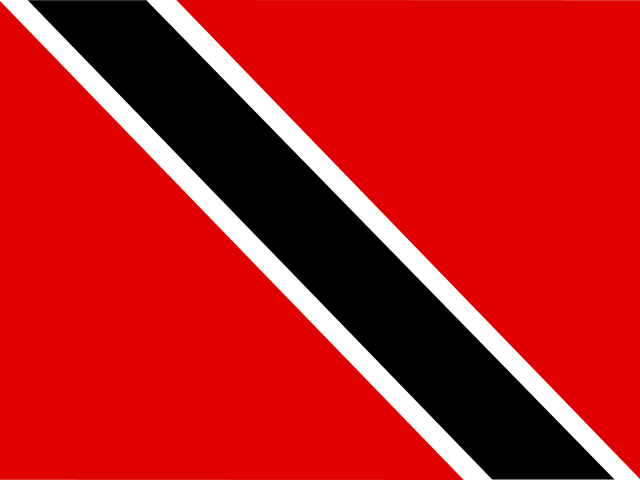
- Red with a white-edged black diagonal band from the upper left to the lower right. The colours stand for earth, water and fire: black for the wealth of the land and the dedication of the people, white for the sea and equality, and red for the sun and the people's courage and friendliness.[1]
- National birds
- The scarlet ibis (for Trinidad) and the cocrico (for Tobago). Both appear on the coat of arms and are protected by law.[3]
- National flower
- The double chaconia, a flaming red forest flower also called the Pride of Trinidad and Tobago.[3]
- National instrument
- The steelpan, invented in Trinidad and Tobago, with its early development in the 1930s and 1940s.[3]
- National anthem
- “Forged From the Love of Liberty” by Patrick Castagne, adopted in 1962. It was first written as an anthem for the West Indies Federation.[1]
Brief history
When Europeans arrived, Trinidad's original inhabitants spoke an Arawakan language, and Carib-speaking people lived on Tobago. Columbus named Trinidad in 1498, possibly after the three peaks he saw on the island.[1][2]
Spain colonised Trinidad first, and Britain took control in the early 19th century. Sugar plantations depended on enslaved Africans until emancipation in 1834.[1]
Between 1845 and 1917 contract workers from India arrived to work on the sugar and cocoa estates. Oil was discovered in 1910 and is still the country's most important industry, alongside natural gas.[1][2]
Independence and government
Trinidad and Tobago became independent on 31 August 1962, with Dr Eric Williams as Prime Minister. It became a republic in 1976, with a President as head of state; the Prime Minister leads the government.[1][2][4]
Notable people
- Dr Eric Williams: Led the People's National Movement from its founding in 1956 and was Prime Minister from independence in 1962 until 1981.[4]
- Patrick Castagne: Wrote the national anthem, “Forged From the Love of Liberty”.[1]
- Hasely Crawford: Won the 100 metres at the 1976 Montreal Olympics, the country's first Olympic gold medal.[5]
Geography
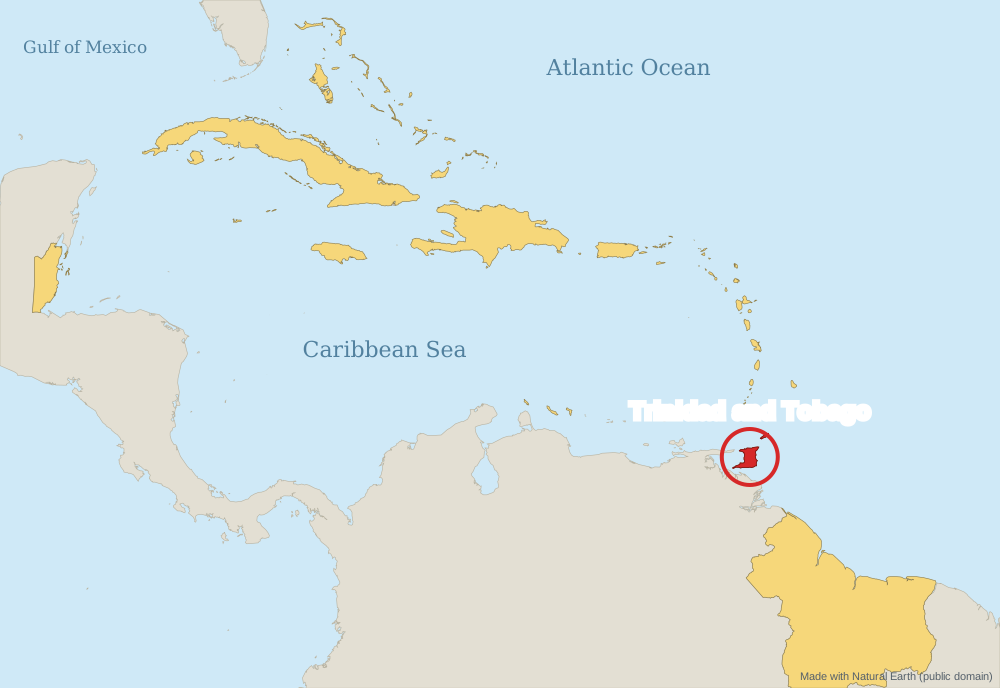
The country is made up of two main islands and several smaller ones. They are the southernmost islands of the Caribbean chain: Trinidad is only about 11 km (7 miles) from Venezuela. Tobago lies about 30 km (20 miles) north-east of Trinidad.[2]
Trinidad's Northern Range is a continuation of mountains in Venezuela and includes El Cerro del Aripo, the highest peak, and waterfalls such as Maracas Falls. Pitch Lake in the south-west is the world's largest natural reservoir of asphalt.[1][2]
The Caroni Swamp is a bird sanctuary and the largest home of the scarlet ibis. Off Tobago, Buccoo Reef is known for its marine life.[2][3]
The climate is tropical, with a rainy season from June to December. The islands lie outside the usual path of hurricanes, though Tobago has occasionally been hit.[1][2]
Culture, festivals, music and food
Carnival and music
Carnival is the biggest celebration of the year, with steelband and calypso music. Steelpans were first made from steel drums or containers, with each section of the playing surface tuned to a note.[2][3]
Festivals of many faiths
Diwali, the Hindu Festival of Lights, is an important festival, especially in Indo-Trinidadian communities, reflecting the islands' mixed heritage.[2]
Food
Street food is famous: doubles are fried flatbreads filled with curried chickpeas, and roti is an Indian flatbread wrapped around vegetables or curried meat.[6]
People
The population includes people of East Indian and African descent and people of mixed heritage, along with smaller communities with European, Asian and Middle Eastern roots.[1][2]
Primary School Trinidad and Tobago in a nutshell
- Trinidad and Tobago is a country made of two main islands. Its capital is Port of Spain.[1]
- It became independent on 31 August 1962.[1]
- The flag is red, with a black stripe edged in white.[1]
- The national birds are the scarlet ibis and the cocrico.[3]
- The steelpan was invented here. It is the national instrument.[3]
- Carnival is a giant festival of music and costumes.[2]
Now try the quiz, or print the fact sheet.
Secondary School Going deeper
A nation of many peoples
After emancipation in 1834, the sugar industry was disrupted. Planters brought contract workers from India between 1845 and 1917, and today people of East Indian and African descent are the two largest groups. This mix shapes the country's festivals, food, music and religions, from Carnival to Diwali.[1][2]
Oil, gas and independence
The discovery of oil in 1910 transformed the economy, and petroleum and natural gas still make the country one of the most prosperous in the Caribbean. Under Eric Williams, Trinidad and Tobago became independent in 1962 and a republic in 1976. Depending on one industry, however, leaves the economy exposed to changes in world energy prices.[1][2][4]
Research questions
- How did the arrival of contract workers from India between 1845 and 1917 change Trinidad and Tobago's culture? Give examples from food, festivals or language.
- Trace the history of the steelpan from the 1930s to its recognition as the national instrument in 2024.
- What are the benefits and risks of an economy built on oil and natural gas?
- Compare Trinidad and Tobago's path to becoming a republic (1976) with Barbados's (2021).
Tip: use at least two sources and note where each fact comes from. The sources below are a good place to start.
Quick quiz
Choose an answer, then press Check. You will find out straight away. Nothing is saved or sent anywhere.
Fact sheet
A one-page summary of Trinidad and Tobago to print or save as a PDF.
Sources
Numbers in square brackets, like [1], show which source each fact comes from. All sources were checked on 12 November 2026.
- The World Factbook: Trinidad and Tobago (final edition, archived January 2026). Central Intelligence Agency (US). web.archive.org/web/2026/https://www.cia.gov/the-world-factbook/countr… (opens in a new tab)
- Trinidad and Tobago. Encyclopaedia Britannica. www.britannica.com/place/Trinidad-and-Tobago (opens in a new tab)
- National Symbols. Office of the President of the Republic of Trinidad and Tobago. otp.tt/trinidad-and-tobago/national-emblems (opens in a new tab)
- Dr. Eric Eustace Williams: Biography. Parliament of the Republic of Trinidad and Tobago. www.ttparliament.org/members/member/dr-eric-eustace-williams/biography… (opens in a new tab)
- Hasely Crawford: 1976 Fastest Man Alive. The National Gas Company of Trinidad and Tobago (NGC). ngc.co.tt/corporate-social-responsibility/above-beyond-programme/hasel… (opens in a new tab)
- Trinidad Traditional & Street Food. Visit Trinidad (Tourism Trinidad). visittrinbago.tt/things-to-do/cuisine (opens in a new tab)
Last reviewed: 12 November 2026 (facts checked against the sources above by the Caribbean Cup of Tea team). Educator review: pending. This is a pilot page awaiting review by a teacher or education specialist.